Saturday, Aug. 12, 2023, at 5 p.m. ~ An "After-Hours" Program on Rare Artifacts at GBMP

Gettysburg, Pa. (July 13, 2023)—Join the Gettysburg Foundation at the Gettysburg National Military Park Museum & Visitor Center Saturday, Aug. 12, 2023, at 5 p.m. for an "after-hours" program on rare artifacts cared for in the archives of the Gettysburg Museum of the American Civil War. Area residents and visitors to Gettysburg are invited to experience “An Evening with the Artifacts“ for an exclusive, close-up look at artifacts of the American Civil War and the Battle of Gettysburg. Gettysburg Foundation president and CEO, author and historian Wayne E. Motts will kick off the new series, presenting rare and one-of-a-kind artifacts in this exclusive behind-the-scenes program. 

The program series features artifacts from the Gettysburg Foundation’s collections formerly owned by the Civil War Museum of Philadelphia, as well as Civil War related three-dimensional items – some of which have never before been on display to the public. Selections to observe during the series come from holdings that include artifacts belonging to George Meade, Ulysses S. Grant and Jefferson Davis, to name a few.

During this new program series, guests can hear the stories and learn about the connections these artifacts have to the people, places and events in our nation’s history. Ticket holders are welcome to enjoy additional time to view these remarkable, authentic Civil War treasures in person. There will be time for a question and answer session during the presentation.

Limited to 50 attendees, the special presentation takes place in the Ford Motor Company Fund Education Center inside the Museum & Visitor Center. To purchase tickets for “An Evening with the Artifacts,” call 717-334-2436 or visit GettysburgFoundation.org. Tickets can also be purchased in advance at the Ticket Counter in the Gettysburg National Military Park Museum & Visitor Center, 1195 Baltimore Pike, Gettysburg, Pa.

Manor College's Civil War Institute presents Via ZOOM "Civil War Medicine" Wed, July 12

The doctors and nurses who treated sick and wounded soldiers faced a daunting task: Antibiotics and the science of bacteriology didn’t exist; crude sanitation and polluted water were deadly. More Civil War soldiers died of disease than of battle wounds. Military doctors had to become medical explorers. And why were there so many amputations?

 If you've ever attended a program or class presented by the popular lecturer Herb Kaufman, you know how interesting his programs are, and how he has a way of ferreting out the unusual stories and incidents of whatever topic he is discussing. As you may know, Herb is an expert on the medical history of the Civil War, and his programs on this topic are always popular and always entertaining.


And as a lover of history, you know how critical it is to keep history alive, especially today! 

We would love to have your support, as we look to continue to make these programs available. Invite a friend!

Please access https://manor.edu/academics/adult-continuing-education/history-institute/  to register for this program.  You will be sent a link with a password that will enable you to access the virtual program. A reminder email will be sent again within 24 hours of the start of the class.


For more information or to sign up via email or phone, please contact coned@manor.edu or call 215-884-2218

"Fighting for Freedom: African Americans in the Civil War" - Monday June 26

THE CIVIL WAR INSTITUTE AT MANOR COLLEGE Presents the ZOOM Program 

"Fighting for Freedom: African Americans in the Civil War"

 Monday, June 26 (6:30 – 8:30 pm)

Instructor:  Paula Gidjunis

Fee: $30


African American men and women – in and out of uniform – were a major part of the Union war effort, and also played a huge role in gaining their own freedom. We will look at these contributions, along with the leadership and work of blacks themselves in the abolition movement and the Underground Railroad. It is estimated that between 25,000 and 50,000 people found freedom through this network.  We will identify many who contributed to that freedom, including some former slaves who became leaders and voices in the Civil War.


Join LOCAL historical reenactor and lecturer, Paula Gidjunis, for this program. 

If you've ever attended a program with Paula, you know her expertise on many history topics, especially on the civilians in the war and on the homefront, and how interesting her presentations are. You're sure to find this program a very moving presentation.
 

 Please access https://manor.edu/academics/adult-continuing-education/history-institute/ to

 register for this program.  You will be sent a link with a password that will enable you to access the virtual program. A reminder email will be sent again within 24 hours of the start of the class.


 And, as a lover of history, you know how critical it is to keep history alive, especially today! 

We would love to have your support, as we look to continue to make these programs available. Invite a friend!

Artists at Gettysburg - a new E-Book by Steven G. Sanders

As the 3-day Battle of Gettysburg raged, on-site visual depictions of the struggle were recording the action real-time. These have been mostly overlooked for over 160 years. Though scholars have scrutinized nearly every aspect of this historic event, drawings and paintings made by eyewitnesses — the only real visual documentation of the action — have all but been forgotten.


Artists at Gettysburg presents this unique collection — the work of two "special artists" and a Union soldier — in full color plates. This 68-page book appeals to art enthusiasts, Civil War buffs, historians, or any reader who enjoys compelling, true stories. Anecdotal essays animate the scenes, place them in context, and evoke the action of the battle. All 63 of these unique artworks have been faithfully reproduced from the originals.


Steve Sanders' fine art education, his 40-year professional career in 3-d design as well as his experience as a tour guide at the White House of the Confederacy Museum, has fostered his interest in historical events containing unique artistic elements. His research in the combat artists of the Civil War inspired him to consider whether any of their 1000s of pieces of extraordinary original art & the stories behind them still existed.


Astonishingly, Alfred Waud and Edwin Forbes, artists working for competing weekly newspapers, actually documented the action as the battle raged on. In addition to a handful of images that have been published previously, the author's painstaking research uncovered more than 4-dozen additional drawings that have rarely been seen.


The collection the author assembled constitutes the only visual documentation of the action created during the battle & its immediate aftermath. It is a compelling, valuable archive that deserves to finally be seen.

Available at this link

ACWM collaborates with Roundtable (92NY) to offer live online courses!


Now Offering Live Online Courses

Roundtable is 92NY’s new destination for live online courses and Q&A with the greatest minds of our time: world-renowned historians, Pulitzer Prize-winning writers, political pundits, and acclaimed food and wine experts. For over 140 years, 92NY has been a world-class community center where people can connect through culture, arts, entertainment, and conversation. Visit Roundtable.org to find more exciting courses in Literature, History, Politics, Arts, and Food & Drink

View Full List of Courses

Emancipation Towns & Migrating Dreams of Freedom and Citizenship
June 15th & 22nd
11:00AM-12:00PM ET

(2 Sessions - “This is Home” & “We Have to Go”)

Overview:

In the aftermath of the Civil War and Emancipation, newly freed men and women established homes and communities of their own. Some migrated west or north, others stayed closer to lands and people they knew, starting with nothing but the determination to begin autonomous lives in a new, uncertain America.

Purchase/Gift this Course

Voices of Abolition
July 13th & 20th
11:00AM-12:00PM ET

(2 Sessions - “From the Fugitive Slave Law to Abolition” & “The Beginnings of an Abolition Movement”)

Overview:

Although African Americans were a driving force in the abolition movement few outside Frederick Douglass and Harriet Tubman are widely known today. Discover the stories of individuals who played a pivotal role in bringing the issue of slavery to the forefront.

Purchase/Gift this Course

One Image, Two Freedom Fighters

August 10th & 17th
11:00AM-12:00PM ET

(2 Sessions - “One Image, Two Freedom Fighters”)

Overview:

The 1864 photo of USCT Pvt. Hubbard Pryor became a national recruitment tool for the US Army and Black male pride in the fight for Emancipation. Then it vanished from memory, only to resurface as a depiction of Gabriel, the enslaved Virginia blacksmith who led a well-organized, if thwarted large-scale rebellion more than 60 years before. What can we learn from the stories of these two men?

Purchase/Gift this Course

First Ladies of the Civil War

November 16th
11:00AM-12:00PM ET

(2 Sessions - “One Image, Two Freedom Fighters”)

Overview:

Although on opposite sides of a divided nation, Varina Davis and Mary Todd Lincoln had much in common. Delve into the lives of these two intriguing women who were First Ladies during the American Civil War.

Purchase/Gift this Course

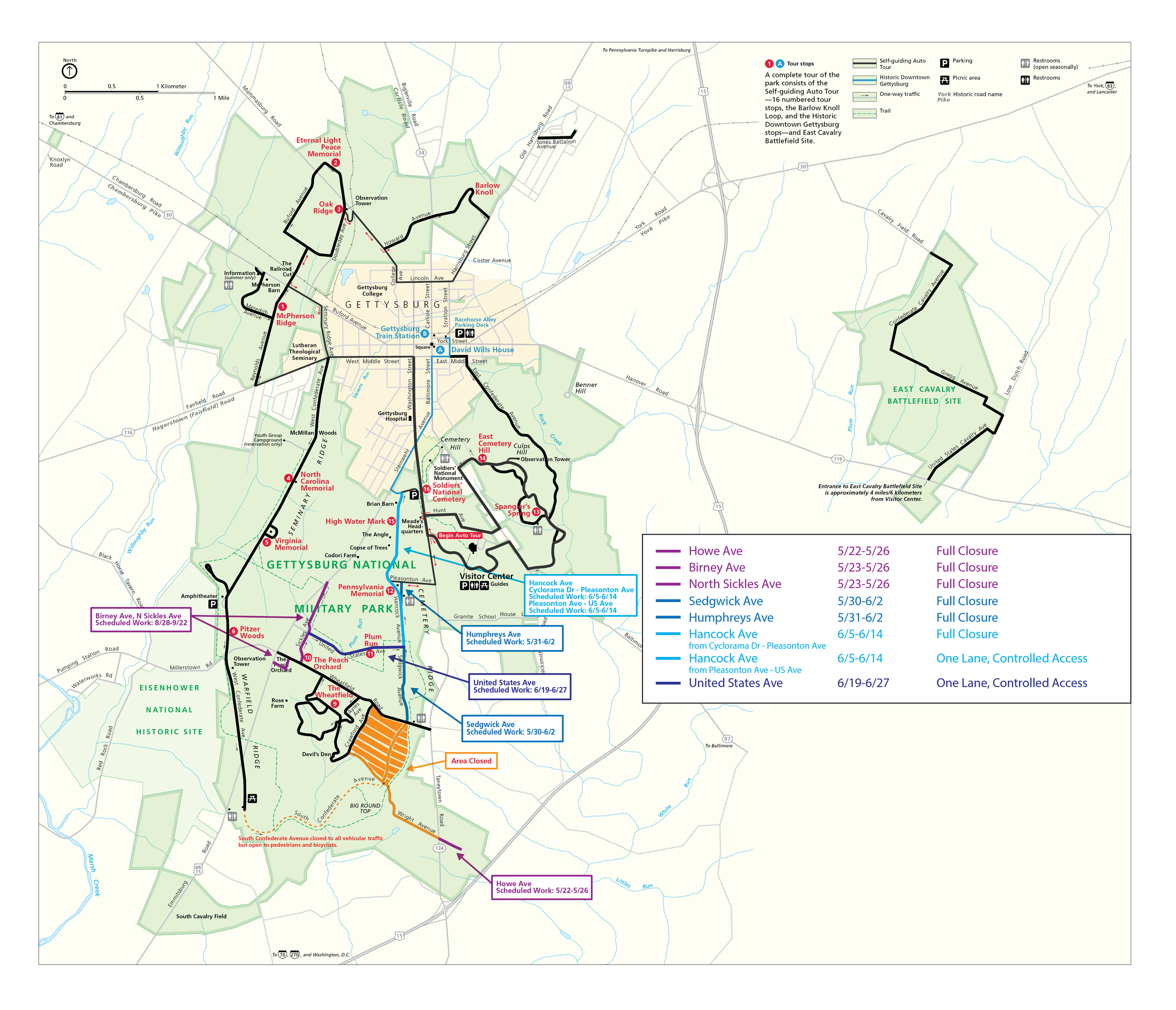
Gettysburg Battlefield Road Construction UPDATES  (Copy)

*** This press release was updated on June 8. It was originally posted on May 19. *** 

Gettysburg National Military Park Announces Upcoming Road Paving Project

  GETTYSBURG, PA – Beginning on June 12, park roads on the southern portion of the battlefield will be repaved. This four-month project will address road surfaces that are at the end of their lifespan.

We have created a new webpage for this project at Road Construction Projects and Closures - Gettysburg National Military Park (U.S. National Park Service) (nps.gov).

This project requires road closures that will temporarily interrupt the ability to visit portions of the battlefield while work is ongoing. Park roads may be fully closed or reduced to a single lane of traffic. However, no work will occur during the events of the 160th Anniversary of the Battle of Gettysburg commemoration from July 1 to 3.

Roads to be repaved beginning in 2023 include: (dates may change due to weather or other impacts)

·       Howe Avenue: 6/12-6/16 – Full Closure.

·       Birney Avenue: 6/13-6/16 – Full Closure.

·       North Sickles Avenue: 6/13-6/16 – Full Closure.

·       Sedgwick Avenue: 6/19-6/22 – Full Closure.

·       Humphreys Avenue: 6/20-6/22 – Full Closure.

·       *South Confederate Avenue: 6/26-7-14 – Full Closure, includes pedestrians and bicycles.*

·       *South Confederate Avenue: 7/1-7/4 – Open to pedestrians and bicycles during the 160th Anniversary of the Battle of Gettysburg.*


Roads to be repaved later in the summer of 2023 include: (dates will be provided when scheduled)

  •      Hancock Avenue.

  •      Ayers Avenue.

  •      Cross/Brooke/Detrobriand Avenues.

  •      South Sickles Avenue, including the Devil’s Den parking lot.

  •      Crawford Avenue.

  •      Wheatfield Avenue.

  •      Berdan Avenue.

  •      West Confederate Avenue, including all associated parking areas.


Scheduled paving dates are subject to change. Every effort will be made to complete the work as expeditiously as possible as well as minimize disruptions for park visitors. Full details on the schedule of road work will be made available on the park website and social media platforms as details become available.

Who:  Gettysburg National Military Park. 

What:  Battlefield road construction. 

Where:  Gettysburg National Military Park, roads on the southern portion of the battlefield.  

When:  Mid-June 2023. 

Gettysburg Battlefield Road Construction UPDATES 

*** This press release was updated on June 8. It was originally posted on May 19. *** 

Gettysburg National Military Park Announces Upcoming Road Paving Project

  GETTYSBURG, PA – Beginning on June 12, park roads on the southern portion of the battlefield will be repaved. This four-month project will address road surfaces that are at the end of their lifespan.

We have created a new webpage for this project at Road Construction Projects and Closures - Gettysburg National Military Park (U.S. National Park Service) (nps.gov).

This project requires road closures that will temporarily interrupt the ability to visit portions of the battlefield while work is ongoing. Park roads may be fully closed or reduced to a single lane of traffic. However, no work will occur during the events of the 160th Anniversary of the Battle of Gettysburg commemoration from July 1 to 3.

Roads to be repaved beginning in 2023 include: (dates may change due to weather or other impacts)

·       Howe Avenue: 6/12-6/16 – Full Closure.

·       Birney Avenue: 6/13-6/16 – Full Closure.

·       North Sickles Avenue: 6/13-6/16 – Full Closure.

·       Sedgwick Avenue: 6/19-6/22 – Full Closure.

·       Humphreys Avenue: 6/20-6/22 – Full Closure.

·       *South Confederate Avenue: 6/26-7-14 – Full Closure, includes pedestrians and bicycles.*

·       *South Confederate Avenue: 7/1-7/4 – Open to pedestrians and bicycles during the 160th Anniversary of the Battle of Gettysburg.*


Roads to be repaved later in the summer of 2023 include: (dates will be provided when scheduled)

  •      Hancock Avenue.

  •      Ayers Avenue.

  •      Cross/Brooke/Detrobriand Avenues.

  •      South Sickles Avenue, including the Devil’s Den parking lot.

  •      Crawford Avenue.

  •      Wheatfield Avenue.

  •      Berdan Avenue.

  •      West Confederate Avenue, including all associated parking areas.


Scheduled paving dates are subject to change. Every effort will be made to complete the work as expeditiously as possible as well as minimize disruptions for park visitors. Full details on the schedule of road work will be made available on the park website and social media platforms as details become available.

Who:  Gettysburg National Military Park. 

What:  Battlefield road construction. 

Where:  Gettysburg National Military Park, roads on the southern portion of the battlefield.  

When:  Mid-June 2023. 

Taneytown Road entrance at Gettysburg NMP Museum and Visitor Center reopens

GETTYSBURG, PA – The Taneytown Road entrance into the Gettysburg National Military Park Museum and Visitor Center will reopen on June 8.

Initially closed on April 1, the Visitor Center Drive required a full replacement. The original asphalt surface had reached the end of its lifespan and was replaced by concrete. All normal operating services and routes that utilize this road will return to normal on June 8.

In addition, Parking Lot 3, and all walking trails adjacent to the construction area will reopen to the public. Alternate roads around the construction area, Hunt Avenue and Granite School House Lane, will return to two-way traffic after they were temporarily made one-way during the project. 

How Many Died in the Civil War?

From History.com
BY: BOB ZELLER PUBLISHED: JANUARY 6, 2022

The Civil War was the deadliest of all American wars. No one disagrees with that. But how many died has long been a matter of debate.

For more than a century, the most-accepted estimate was about 620,000 dead. A specific figure of 618,222 is often cited, with 360,222 Union deaths and 258,000 Confederate deaths.

This estimate was not an unreasoned guess, but a number that was established after years of research in the late 19th century by Union veterans William F. Fox, Thomas Leonard Livermore and others. Their work involved an exhaustive examination of army documents, muster rolls, cemetery records, census records, pension records and other resources and documents. In 1900, Livermore published a 171-page book of his work, Numbers and Losses in the Civil War in America 1861-1865.

2011 Analysis Raises Estimate

But in 2011, demographic historian Dr. J. David Hacker published “A Census-Based Count of Civil War Dead,” in the scholarly quarterly, Civil War History, reporting that his in-depth study of recently digitized census data concluded that a more accurate estimate of Civil War deaths is about 750,000, with a range from 650.000 to as many as 850,000 dead.

Hacker, an associate professor of history at the University of Minnesota, believed that a fresh, detailed examination of the numbers from the 1850, 1860 and 1870 U.S. census tabulations might reveal a massive reduction for the young male population in 1870 that would reflect the human toll of the war. And that is what he found. Hacker’s research concluded that the normal survival pattern for young American men from 1860 to 1870 was far less—by about 750,000—than it would have been had no war occurred.

Civil War History called Hacker’s findings “among the most consequential pieces” it has ever published. “It even further elevates the significance of the Civil War and makes a dramatic statement about how the war is a central moment in American history,” said Civil War historian Eric Foner.

“The first thing to stress is this is an estimate of the number of men missing in 1870. It is adjusted for possible census undercount and other things,” Hacker tells HISTORY. “It is not an estimate of the number of people who died on the battlefield. And why are these men missing? I think the only reasonable reason they're missing is because of the Civil War.”

Lack of Written Records Present Challenge

SSPL/GETTY IMAGES

A PRINT OF A DEAD SOLDIER AT DEVIL'S DEN ON THE BATTLEFIELD AT GETTYSBURG, BY ALEXANDER GARDENER (1821-1882) FROM A NEGATIVE PRODUCED BY TIMOTHY H O'SULLIVAN (1840-1882). THE DEVIL'S DEN WAS THE SCENE OF BITTER FIGHTING DURING THE SECOND DAY OF THE BATTLE OF GETTYSBURG.

Many Civil War historians have believed the 620,000 estimate to be too low, especially on the Confederate side, given the lack of written records and the estimate’s questionable assumption that men in the Confederate army died of disease at the same rate as men in the Union army.

“I think that there's been a long, long belief among historians that the numbers that we've been citing for a century or more are not based on solid data but were in fact, crude estimates that were likely to be underreported,” Hacker says. “And for that reason, I think, the results of my study verified in some people's minds exactly what they had long suspected.”

The American Battlefield Trust, however, says it will continue to cite the estimate of 620,000. It praised Hacker’s initiative, but said his estimated range of 650,000 to 850,000 “is very broad, includes civilian casualties, and is not directly linked to the war years of 1861-1865.”

“They say, ‘How can you publish a number with that big of a possible error range (650,000 to 850,000)?’” Hacker says. “So they’re going to stay with a number that we all know is CLICK HERE FOR THE FULL STORY

Gettysburg's Witness Trees - Rooted in History

The following is from CBS News files - July 8, 2018

If July the 4th represents the birth of our country, another event in the same month speaks to something else: a time when our nation was put to the test during the Battle of Gettysburg in Pennsylvania. Mark Strassmann has the story of some Civil War era-trees standing witness:

Gettysburg … America's Armageddon. In July 1863, two great armies, the Blue and the Gray, collided on these fields for three days. It remains the bloodiest battle in U.S. history. 

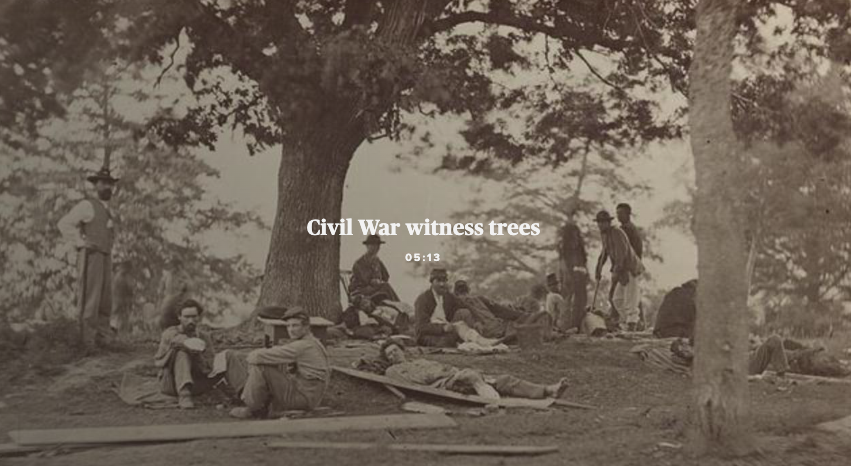
And improbably, 155 years later, there are still living witnesses to that moment in time, otherwise gone to dust and glory: The trees.

Across 6,000 acres of Gettysburg National Military Park, rangers have documented at least a dozen "witness trees" that were alive during the battle - living links that help tell the story of the battle.

"For many years after the Battle of Gettysburg, we had the veterans that we could speak with, or we would have the descendants of the veterans that we could speak with," said Supervisory Park Ranger Angie Atkinson. "And so now the closest living connection are these trees."

The Sickles Tree

A Massachusetts bugler sketched a swamp oak growing next to Union General Daniel Sickles' headquarters. Today, this massive landmark is known as the Sickles Tree.

Correspondent Mark Strassmann and Supervisory Park Ranger Angie Atkinson visit the Sickles Tree at Gettysburg National Military Park, which was alive at the time the Battle of Gettysburg was fought.CBS NEWS

"It witnessed a general contemplating a decision, whether or not to move his men forward," said Ranger Atkinson. "And even today, it stands here as a witness to people who are still visiting this battlefield 155 years later."

These Witness Trees remind park visitors, of every age, that the Civil War is hardly ancient history. 

Inside the park's visitors' center, a tree limb on display isClick here for the full story