Filming Wraps for “Gettysburg 1863”

Filming wraps on ‘Gettysburg 1863,’ premiere planned for fall

February 2, 2026 by Gettysburg Connection News Team

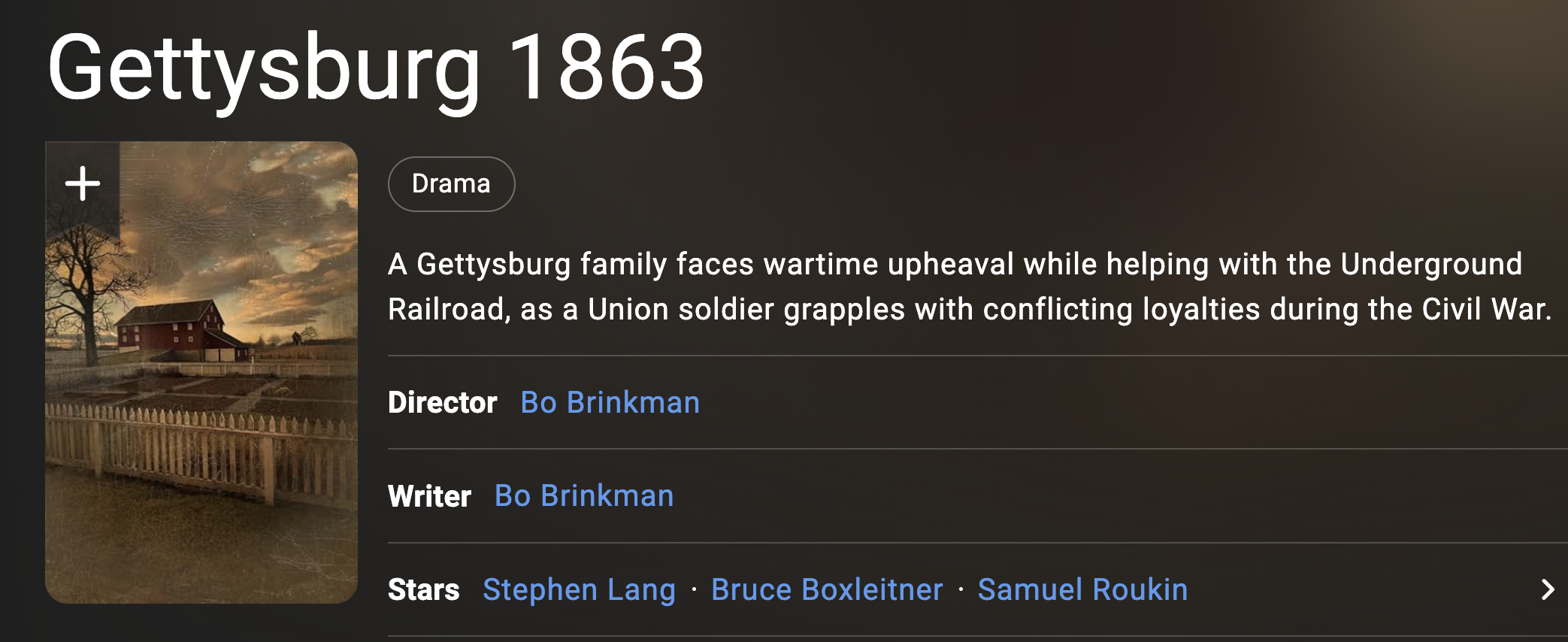
Weeks of on-location filming for the new historical drama Gettysburg 1863 have officially wrapped, bringing to a close a production that spanned multiple states and several landmark sites tied to the region’s Civil War legacy.

According to a post shared Friday by Dobbin House Tavern, the film was shot across Harpers Ferry, Loudoun Heights, and numerous locations throughout Adams County. In Gettysburg, cameras rolled at several familiar settings, including the Dobbin House Tavern and the Shriver House Museum, offering residents and visitors a close-up look at the production in action.

With principal photography complete, the project now moves into post-production, where editors and music producers will shape the finished film. Organizers are preparing for a planned Gettysburg premiere later this fall, giving the local community an early opportunity to see the completed work before its wider release.

Those involved with the production say the film is expected to be visually striking and emotionally resonant. Observers on set described a project marked by careful attention to atmosphere, period detail, and storytelling, aiming to capture the mood of a community grappling with the aftermath of war rather than the conflict itself.

Unlike many films associated with Gettysburg, Gettysburg 1863 does not retell the famous three-day battle. Instead, its narrative is set in the difficult months that followed. The story centers on a shaken town learning how to move forward amid grief and uncertainty, portraying families who rely on faith, compassion, and one another to endure loss and hardship. Running parallel is the story of a young soldier fighting to survive far from home, adding a personal dimension to the broader themes of recovery and resilience.

The filmmakers emphasize that this post-battle focus allows the story to explore the human cost of war and the quiet strength found in community, offering a perspective not often seen in Civil War-era films set in Gettysburg.

Residents and history enthusiasts interested in the production can find behind-the-scenes photos, videos, and cast stories by following Dobbin House Tavern, Gettysburg History, and the Gettysburg Film Commission on Facebook, Instagram, and YouTube.

The full-length film is slated to arrive in theaters and on streaming platforms in late 2026.

Source: The Dobbin House

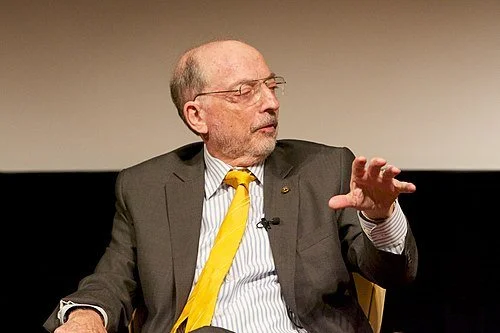
Gabor S. Boritt, renowned author, scholar of Abraham Lincoln and the American Civil War, founder of the Civil War Institute at Gettysburg College

Gabor S. Boritt, renowned author, scholar of Abraham Lincoln and the American Civil War, founder of the Civil War Institute at Gettysburg College, and co-founder of the Gilder-Lehrman Institute of American History and the Lincoln Prize, died on February 2, 2026. He was 86, having just entered his four score and seventh year.

Boritt spent his childhood in war-torn, fascist-controlled Hungary during World War II and the Soviet occupation. A participant in the 1956 Hungarian Revolution, he escaped the country after the Russian invasion and came to America as a refugee, ultimately settling on a historic farm near Gettysburg, Pennsylvania, where he spent the remaining 43 years of his life.

Ken Burns, documentarian: “Gabor Boritt was a towering figure in Civil War and Lincoln scholarship. He had a profound influence on my understanding of that period and that man, as well as my work. And he was a good friend—for decades. His loss is immeasurable.”

Karl Rove, former senior advisor to President George W. Bush: “Gabor Boritt was a great man and a symbol of the promise of our country. To have escaped Hungary, come to the shores of this country with nothing, and to have become one of America’s leading historians is such a wonderful story.”

Stephen Lang, actor: “As a scholar and historian Gabor Boritt was of the highest caliber. To be in his presence was to engage with not only a first-rate intellect but a raconteur of rare skill. Gabor was a serious man with a serious twinkle in his eye. I will cherish the memory of his kindness and his laughter.”

Harold Holzer, Jonathan F. Fanton Director of the Roosevelt House Public Policy Institute at Hunter College: “Gabor Boritt was that rarest of figures: a groundbreaking scholar, a brilliant teacher, a highly gifted writer, and a magnetic public historian who brought people together across generations to engage in the American saga. He revolutionized our view of Lincoln’s economic beliefs, produced highly influential landmark books, and over the years convened tens of thousands of college students, fellow historians, lifelong learners, and enthusiasts at special conferences. Gabor was all this, and a role model as a born-again American—a shining example of why immigration makes our country greater, and our collective story brighter.”

Dr. Ian Isherwood, associate professor of War and Memory Studies and director of the Civil War Institute at Gettysburg College: “Professor Boritt had a profound impact on the field of Civil War Era Studies and on the study of history at Gettysburg College. The founding of the Civil War Institute was a landmark moment in the field.”

Andrew Dalton, President & CEO of Gettysburg History: “Gabor was a tireless advocate for this place, not just as a scholar but as a citizen of Gettysburg in the deepest sense. He loved this town fiercely, and Gettysburg loved him right back. He will be sorely missed.”

Michael Birkner: Gabor’s vision and the energy he put behind it made Gettysburg College a real force in the national conversation about the American Civil War. His enthusiasm for learning rubbed off on his students, his friends, and young scholars in particular. Few scholars have had his impact, and we are better for it.

Gabor was born on January 26, 1940, in Budapest, Hungary, to Rozsa and Pal Roth-Szappanos (in the United States their surname would be changed to Boritt). Gabor was the youngest of three children in a Jewish family that included his brother Adam and sister Judy. For the first four years of his life, the family lived in a stone house in the wealthy Rózsadomb area in the hills of Buda as World War II engulfed Europe. In March 1944, Nazi forces took over Hungary and Hitler’s “Final Solution,” the aim of which was the systemic eradication of the Jewish people, began to be implemented across the country. Gabor’s grandfather’s family was deported from rural Transylvania and murdered at Auschwitz.

Gabor’s immediate family of five was forced from their home. They found refuge in the janitor’s closet of 44 Wesselényi utca, a school that had been converted into a makeshift hospital on the edge of the Budapest ghetto. Gabor’s father Pal helped lead resistance efforts against the Nazis by rescuing potential deportees from train platforms. While their father was away, the family was once threatened by a Nazi thug waving a pistol. It was an exceptionally cold winter, and the frozen bodies of the dead were stacked in the courtyard of the makeshift hospital, eventually reaching beyond the first floor windows. The Soviet army began a siege of Budapest in December of 1944. Allied planes dropped bombs on the city. Gabor recalled to his son a shell striking the floor of the building near where his family had been sitting.

By the end of the war, Budapest was in ruins and Hungary was firmly in Stalin’s grip. Soon thereafter, after Gabor’s mother died suddenly—an emotional wound he carried with him for the rest of his life—and his father and brother were imprisoned, he was sent to an orphanage. He remembered that it was a tough place and he was a small guy, but here he learned that when he got knocked down, he had to get back up.

In 1956, 16-year-old Gabor joined the Hungarian Revolution. He participated in protests on October 23. Riding on vehicles through the city, they shouted “Ruszkik, haza!”—“Russians, go home!” He joined a group that was attempting to pull down a massive statue of Jozef Stalin. Gabor helped fetch ropes and, by the time he returned, the statue had been toppled and the crowd had broken off pieces. Gabor took a piece of the statue as a memento. Later, he described the euphoria of the revolution in his son Jake’s documentary Budapest to Gettysburg: “We thought it was a whole new world. Anything was possible.”

Just days later, 3,000 Soviet tanks crushed those possibilities. Gabor’s father Pal had helped get supplies to the revolution but realized his family must flee. The family apartment building on Teréz körút was bombarded by Russian tanks while they sheltered in the basement. As the building partially collapsed, Gabor and his family escaped. While his elder brother, Adam, left immediately, their father told Gabor and his sister Judith to go to an English-speaking country. They headed for the Austrian border and, in darkness, hiked through wooded hills until they came to a no-man’s-land guarded by watchtowers and soldiers with machine guns. Freedom lay on the other side. Together, they started running.

Upon reaching Austria, Gabor got his first taste of free society. The first thing he wanted was the drink forbidden to him behind the iron curtain: Coca-Cola. When he finally tasted a Coke, he was disappointed. After spending months at an Austrian refugee camp, Gabor came to America—President Dwight Eisenhower had welcomed 40,000 Hungarian refugees to the United States—with just one dollar in his pocket, sent to him by his brother.

Gabor arrived in the “dirtiest city” he had ever seen: New York. He worked in a hat factory. Here he was told that America is “out west,” so he headed to South Dakota. Gabor wanted to learn English, so, in 1959, he picked up a free booklet of Abraham Lincoln’s writings. Captivated by Lincoln’s mastery of the language and his rise from poverty to the presidency, he began studying American history and obtained a Bachelor of Arts degree from Yankton College in 1962, followed by a master’s degree from the University of South Dakota the next year. Soon after, Gabor decided to continue his studies, eventually earning a Ph.D. from Boston University in 1968.

As an immigrant, he felt obliged to go to Vietnam, where he taught soldiers about the American Civil War in Phuket and Danang, as well as at other military bases in Asia.

In 1978, he published his first book, Lincoln and the Economics of the American Dream. The opening lines of the book read: “In the beginning were the land and the dream. The land, Robert Frost has written, was ‘vaguely realizing westward, but still unstoried, artless, unenhanced.’ The dream was as old as mankind, of the ‘city upon a hill,’ a light to the world, where men were endowed with the right to rise in life.” The book constituted an original and groundbreaking study of Lincoln’s beliefs and was nominated for the Pulitzer Prize. A survey of leading experts by Civil War Times lists the book among the ten most important books ever written about the 16th president.

Gabor loved teaching. A dedicated professor, Gabor had academic appointments at Harvard University, the University of Michigan, Washington University in St. Louis, and Memphis State, before arriving at Gettysburg College, mere blocks from where Lincoln had delivered his most famous address, in 1981.

As a professor at Gettysburg College, Gabor taught American history to students over many decades. He founded the Civil War Institute and, with the help of philanthropists Richard Gilder and Lewis Lehrman, established the $50,000 Lincoln Prize, which is widely considered the most coveted award for the study of American history. He also helped create the Gilder Lehrman Institute, a leader in improving the teaching of history in schools, and served on the board of the Gettysburg Foundation, helping to build a new visitor center for Gettysburg National Military Park.

Beyond this, Gabor was a renowned and highly sought-after guide on the Gettysburg battlefield. He guided luminaires such as Supreme Court Justice Sandra Day O’Connor, actor Charlton Heston, author Elie Wiesel, and General Colin Powell, along with foreign leaders, including Colombian President Alvaro Uribe Velez and Israeli Chief of Defense Moshe Levy. In September 2008, Gabor gave a tour of the Gettysburg battlefield to President George W. Bush, Laura Bush, and a group that included White House Advisor Karl Rove, Former Attorney General Alberto Gonzalez, and Secretary of Education Margaret Spellings.

Among his other books are The Lincoln Image, The Confederate Image, The Gettysburg Nobody Knows, and The Lincoln Enigma.

In 2006, he published The Gettysburg Gospel: The Lincoln Speech Nobody Knows. It was featured on the cover of U.S. News and World Report and described as “fascinating” by The New York Times. Gabor wrote of the speech Lincoln delivered in the midst of the buried Union dead at Gettysburg: “Gettysburg, after the battle, is the site of the greatest man-made disaster in American history. This is where the president came to explain why a bloody war had to go on. ‘Gospel’ suggests spiritual rebirth. When Lincoln’s words are best understood, they bring that potential to Americans, indeed to people everywhere. His words pointing to rebirth went even deeper than the Christian message, if that was possible, reaching the primeval longing for a new birth that humankind has yearned for and celebrated with every spring since time immemorial.”

At the White House in 2008, President George W. Bush honored Gabor with the National Humanities Medal for a distinguished career of scholarship on Lincoln and the Civil War era, commenting, “His life’s work and his life’s story stand as testaments to our Nation’s precious legacy of liberty.”

The film Budapest to Gettysburg, a documentary by his son Jake Boritt, chronicles Gabor’s history in Hungary and his work on Lincoln and the Civil War. It follows Gabor’s return to Hungary to explore the epic history of his youth that he had heretofore refused to study, and how it had contributed to his important work on Lincoln, the Civil War, and American freedom.

Personal

As a graduate teaching assistant at Boston University, Gabor met Elizabeth Lincoln Norseen (Liz) in 1963 when she entered his class late and required after-class help. In 1968, they married on Elizabeth’s family farm in Bolton, Massachusetts. In 1983, they purchased an abandoned farm near Gettysburg on the banks of Marsh Creek and restored the circa 1799 stone house on the property themselves. It had once been the home of Basil Biggs, a free Black man who used the house as an Underground Railroad stop to help runaways escape enslavement. During the Battle of Gettysburg, the farm was used as a major field hospital by Confederate soldiers under William Barksdale (Mississippi) and Paul Jones Semmes (Georgia). At least 48 Confederate bodies were buried on the farm. It is likely the only Gettysburg home used as both an Underground Railroad stop and a Confederate field hospital. Gabor lived on the farm for exactly half of his life until his final days.

Gabor and Liz had three children: Beowulf Norseen Boritt (1970), a Tony Award-winning set designer living in New York City; Jake Boritt (1975), a documentary filmmaker and founder of the Gettysburg Film Festival; and Dan Boritt (1980), who serves as executive director of the Indiana Wildlife Federation.

After suffering some serious health issues, Gabor retired to live on his farm in Gettysburg with his wife. They were eventually joined by his son Jake and his family, which included three of his grandchildren, whom he enjoyed pushing in swings and chasing as “Tata Monster.” He enjoyed sitting on the porch by the creek singing favorite songs, including “Oh What a Beautiful Morning” and “Hava Nagila.”

Gabor is survived by his wife Liz; his son Beowulf; his son Dan, his wife Katie Moreau and their children, Henry and Leo; and his son Jake, his wife Heather Ross, and their children, Lincoln, Ellis, and Sadie Rozsa.

In lieu of flowers, please consider making a donation in Gabor’s memory to:

Gabor S. Boritt Endowed Fund Gettysburg College Civil War Institute 300 N. Washington Street, Gettysburg PA 17325 Gabor S. Boritt Endowed Fund https://www.gettysburg.edu/civil-war-institute/funding-priorities/

 Zoom Interview of Lincoln Scholar Dr. Michael Burlingame on Fri Feb 20 at 11am

Dear Mr. Root,

Did you know that at last count, 16,000 books and articles have been published about Abraham Lincoln? No other figure in American History has ever generated this kind of response.

I’m pleased to announce that on Fri. Feb. 20th at 11:00am, I will be interviewing Dr. Michael Burlingame, a Lincoln scholar based at the University of Illinois.

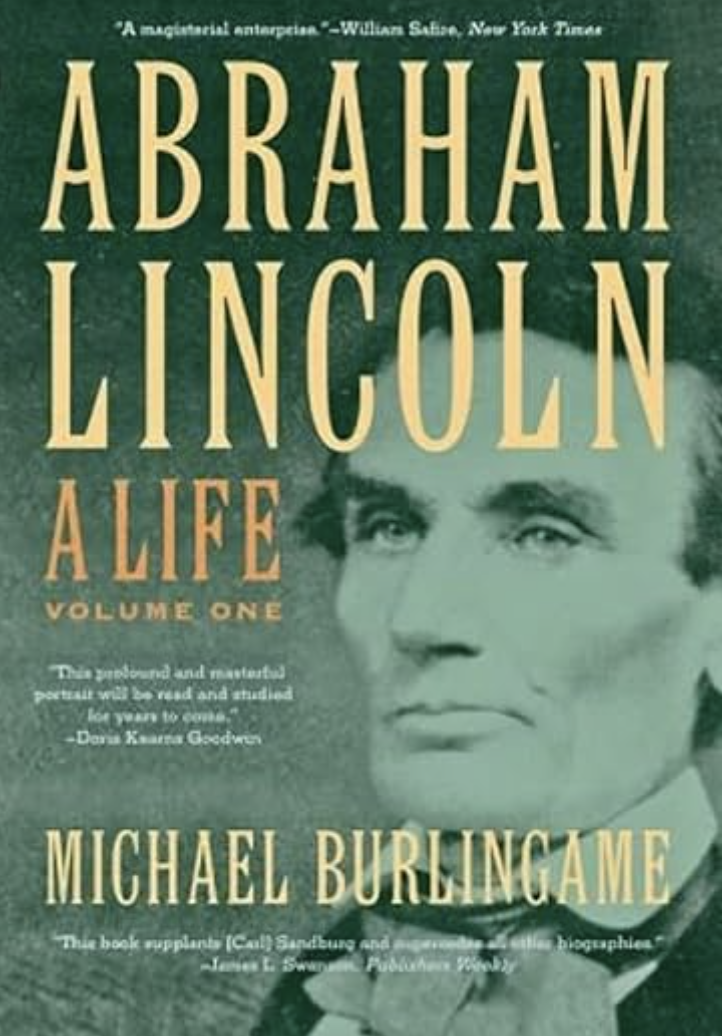
He is the author of Lincoln: A Life. This two-volume work has been acclaimed by Burlingame’s peers as the definitive biography of our 16th President.

In writing it, Burlingame has created a new standard for what a great biography is supposed to be. Critics and scholars agree that Burlingame knows more about the life of Abraham Lincoln than any other person now living.

To register for this remarkable program, please click on the dedicated registration link below.

  https://freelibrary-org.zoom.us/webinar/register/WN_zeaarGegQKWaduRSWziTHA  

You may have to hold down the Control Key, while you click the link.  

 Dick Levinson
Free Library of Philadelphia
levinsonr@freelibrary.org  

Free Zoom Program on Frederick Douglass on Sun Feb 1


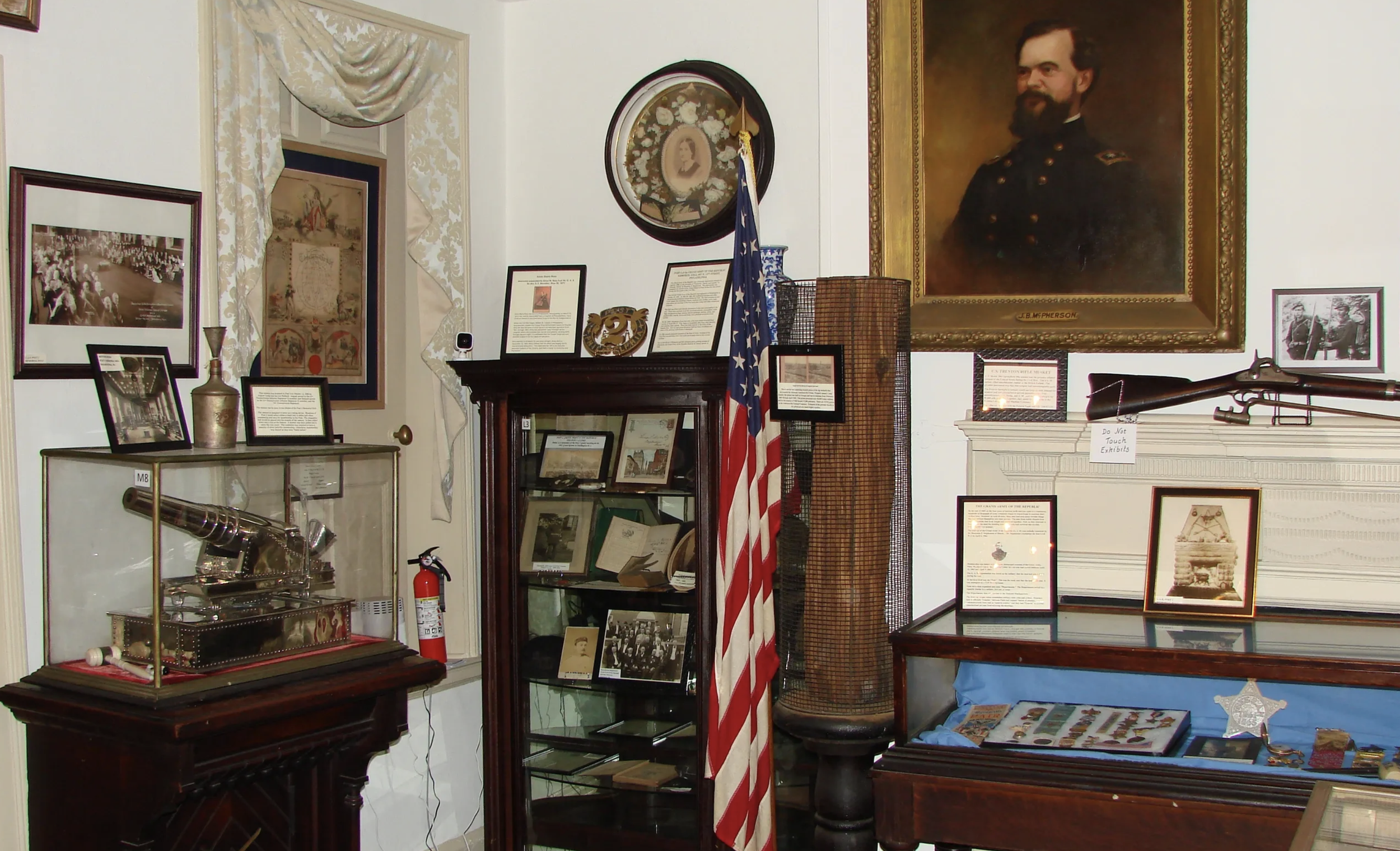
THE GRAND ARMY OF THE REPUBLIC (G.A.R.) CIVIL WAR

MUSEUM & ARCHIVE

Presents a Free Zoom Program

 Sunday, February 1, 2026 at 1:00 p.m.

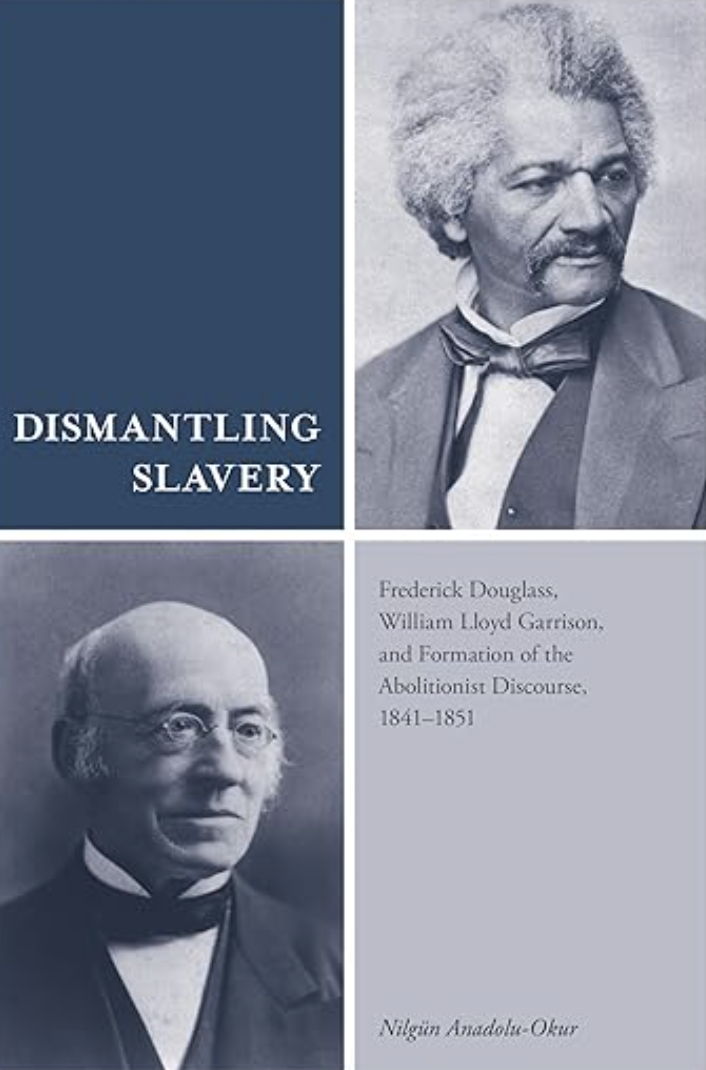
 “Frederick Douglass” by Prof. Nilgun Anadolu-Okur, Temple University

 Frederick Douglass rose to prominence as an eloquent author, intellectual and human rights advocate, as well as a women's rights leader. He was the first African American to hold high U.S. government ranks, as a diplomat in the Dominican Republic and Haiti, and the first to be nominated for vice president. In her talk, Professor Okur will highlight Douglass's lesser known characteristics.

 Dr. Nilgün Anadolu-Okur is the Presidential Professor of Africology and African American Studies at Temple University’s College of Liberal Arts. She holds an interdisciplinary Ph.D. in African American and American Studies. She has two Fulbright appointments internationally and she has received grants and national awards in humanities. Currently she serves as chair of the Faculty Senate Status of Women Committee and as the Graduate Director of her department. In 1990s as the Pennsylvania Humanities Council (PHC) Commonwealth Speaker she toured Pennsylvania and lectured on Underground Railroad and Black Abolitionists. She is the co-founder of the “Annual Underground Railroad Conference at Temple University,” since 2003. She has authored books on African American Studies and her articles are published in peer-reviewed journals including Journal of Black Studies, Gender Issues, Human and Society. Her research has a broad spectrum ranging from theory and methodology in Africology and Afrocentricity, race and racism, women’s rights, abolition, Black Women authors (19th to 21st century), African American history, and motherhood in antiquity.

To reserve a virtual seat for this outstanding presentation, reply by e-mail to garmuslib1866@gmail.com

 You will be sent a link with a password that will enable you to access the program within 24 hours of the start of the presentation. 

 Deadline for signing-up is Noon, Saturday, January 31, 2026

 As a lover of history, you know how critical it is to keep history alive, especially today.  We very much appreciate your continued support for the GAR Civil War Museum & Archive

 GRAND ARMY OF THE REPUBLIC MUSEUM & ARCHIVE
8110 Frankford Ave. (Holmesburg - N.E. Philadelphia), 19136
 www.garmuslib.org

Filming "Gettysburg 1863" in Gettysburg

From ABC 27 News

GETTYSBURG, Pa. (WHTM) — The star of one of last year’s biggest movies will get his next credit in Gettysburg.

Stephen Lang will portray John L. Burns, a civilian combatant with the Union, in “Gettysburg 1863,” which resumed filming this month in the borough. He comes off the box office hit “Avatar: Fire and Ash,” in which he played Miles Quaritch.

Jake Busey, Bruce Boxleitner, Shannon Lucio, Eric Nelsen, and Drew Seltzer will join him as costars.

The indie film chronicles the life of a mother, three daughters, and a father who’s away fighting in the war. Filmmakers transformed Gettysburg back to the Civil War period for the project, including covering Baltimore Street with dirt.

Bo Brinkman is directing the film. He starred in the 1993 epic “Gettysburg” as Walter H. Taylor, the aide-de-camp for Gen. Robert E. Lee. Lang portrayed Gen. George Pickett in that movie.

“I fell in love with the town and the history, and I’ve been coming back ever since,” Brinkman said in an interview with abc27 News last year. “Gettysburg is special, and out of all the other towns in this country, because people are still living the history and they’re passionate about the history.”

The film is set to premiere later this year.

https://www.abc27.com/video/avatar-stars-next-role-brings-him-to-gettysburg/11428188

2026 Civil War Music Concert now on YouTube

The GAR Museum 2026 band Concert is now on our YouTube channel:

https://www.youtube.com/@garmuseum

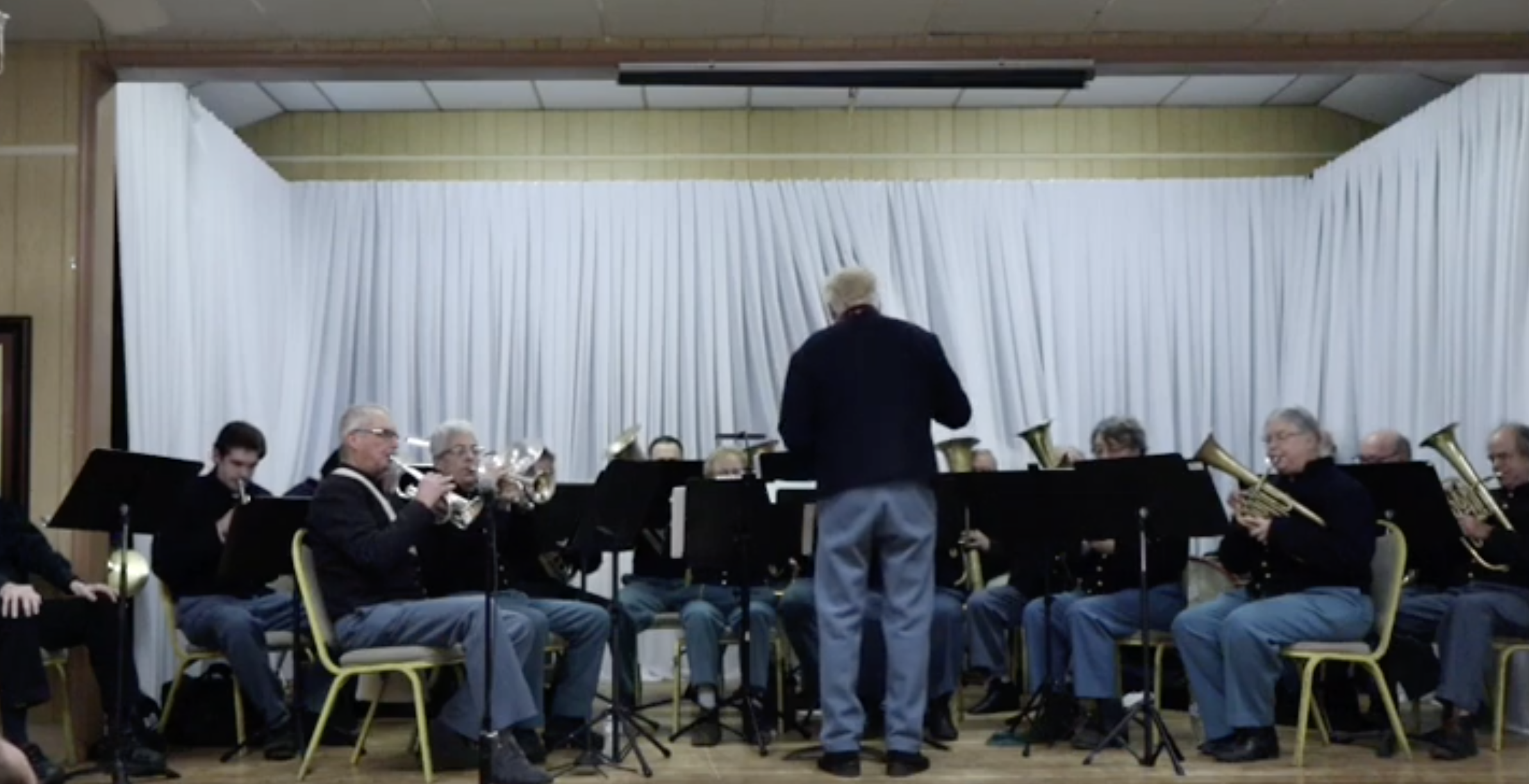
Becks' Philadelphia Brigade Band is a Civil War era brass band portraying the brass band of the 2nd Division, 2ndCorps, 2nd Brigade of the Union Army of the Potomac in 1863. The Band plays the music of the Victorian era for concerts, ceremonies, balls, parades and commemorations. The band is authentically uniformed, playing music of the period on instruments that were correct for the time.  The program featured tunes played during the Civil War era, including Christmas songs that date back to the 1850's, plus some vocal renditions from that period. Songs will include "Cheer Boys Cheer", "Battle Hymn of the Republic", "Shenandoah", "Battle Cry of Freedom", and "Dixie" (a personal favorite of President Lincoln.)

The music comes from manuscripts dating back to 1830, publications courtesy of the Library of Congress, and arrangements created for the band by our own members.

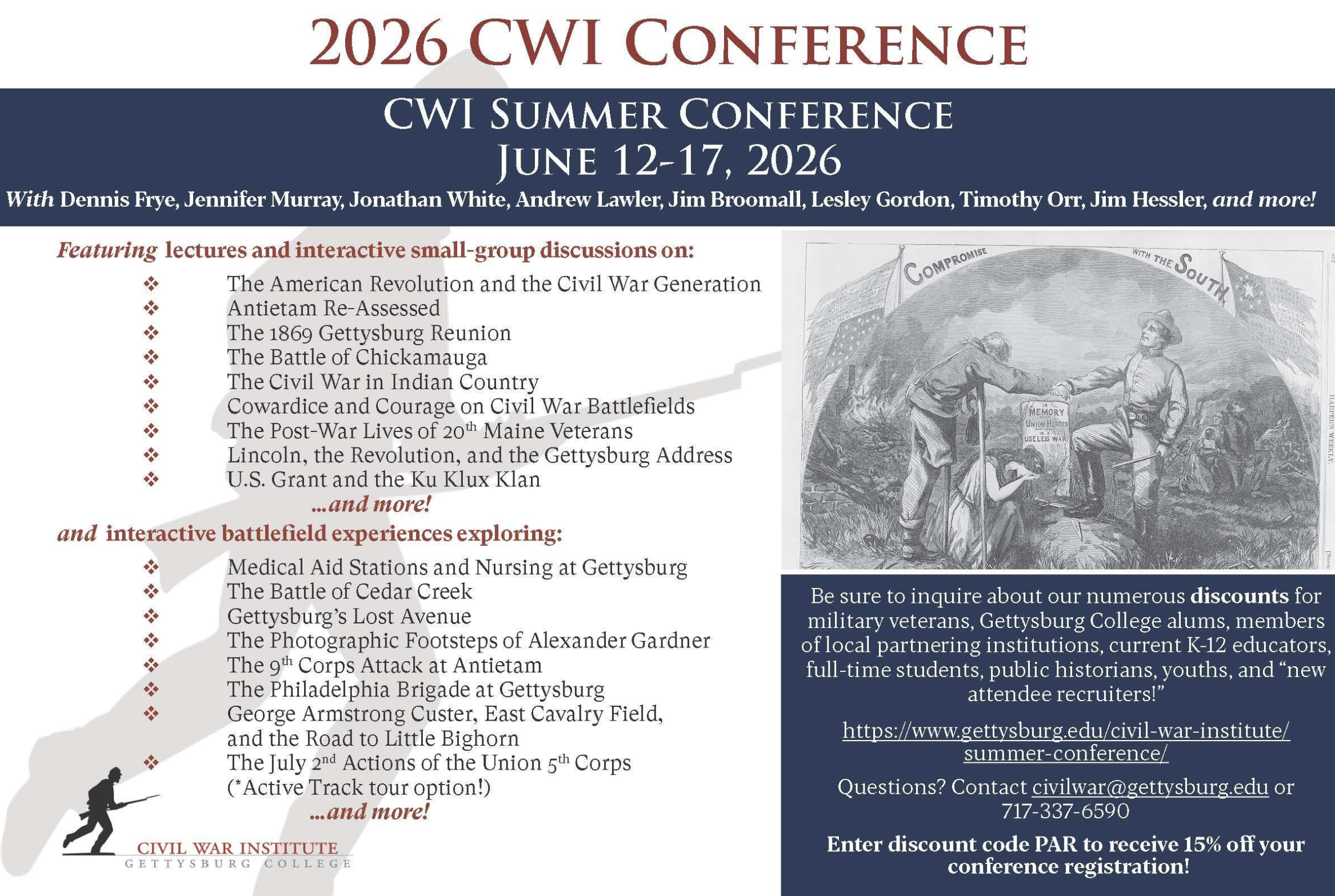
2026 Civil War Institute Summer Conference - 15% Discount for CWRT Members!!

Dear Friends,

The Civil War Institute at Gettysburg College would like to offer members of your Civil War Roundtable or organization a 15% discount to attend the 2026 CWI Summer Conference, June 12-17. You can explore further details about our conference on our website, as well as check out our schedule for this year’s event. At CWI, we believe in the mission of CWRTs, and we are making this special offer to recognize the efforts of your organization in promoting the study of Civil War history. Please let us know if you intend to make this special offer known to your membership, and feel free to use any language from this email or the attached promotional card for your newsletter.

We are also happy to provide additional promotional materials, such as flyers or postcards, for you to distribute or use for advertising. If you are interested, please email our administrative assistant, Triada Chavis, directly at tchavis@gettyburg.edu.

We hope to have the opportunity to work with you to help continue the educational missions of both your Round Table and the Civil War Institute. Please let me know if you have any questions, and we look forward to hearing from you in the near future.

Kind regards,
The CWI Team
SEE BELOW FOR MORE DETAILS

Hershey Roundtable Zoom Presentation Thursday Jan 15 - Battle of Franklin

Thursday, January 15 7:30pm to 9:00pm William White

Battle of Franklin Tennessee “Let’s Die As Men” (ZOOM)

One of the worst disasters for the Confederate States Army took place on November 30, 1864 in Franklin,

Tennessee. A series of costly assaults by Lt. Gen. John Bell Hood's Army of Tennessee against fortified

Union positions along the south side of the town of Franklin, have caused the battle to be likened to

Gettysburg's final day, as the “Pickett’s Charge of the West.” However, until recently it has been a battle

dominated by myth and over simplification, and that is something the author is working to correct.

Union Maj. Gen. John Schofield’s forces held their positions and inflicted devastating losses on the enemy

to include fourteen generals being killed, wounded and one was captured.

We invite you to come hear about an aspect of the American Civil war that is not talked or taught much

about.

About our Speaker:

William Lee White is a park ranger at the Chickamauga and Chattanooga National Military Park, where he

gives tours and other programs at the Chickamauga and Lookout Mountain Battlefields. He is the author

of Bushwhacking on a Grand Scale: The Battle of Chickamauga and Let Us Die Like Men: The Battle of

Franklin, both part of the Emerging Civil War Series, as well as several articles and essays on topics

related to the Western Theater.

https://us02web.zoom.us/j/82234887393?pwd=a281bG5nTGcyVkw5WEVZTTBOSmYxZz09

Meeting ID: 822 3488 7393

Passcode: 628861

If you encounter any problems with Zoom or Facebook Live, please call Ricky Hollis (717) 805-7502 and

let him know what the problems is.

History of the GAR Museum told in Feasterville

History of the Grand Army of the Republic Museum

Join Walt Lafty and Mary Wible as they share the history of the Grand Army of the Republic Museum and Archive, highlight parts of the collection, share artifacts, and provide samples of records and documents of Civil War veterans and the interesting stories behind them. 

Questions? Contact Chryssi at guminac@buckslib.org or 215-355-1183, ext. 104 

 Date: Wednesday, January 21, 2026

Time: 10:00am - 11:00am

Campus: Bucks County Free Library Feasterville

Categories:   Adults  

Registration is required. There are 41 seats available.

Gettysburg Battlefield monuments defaced with oily substance

Gettysburg Times reports on January 12 that “Oil-based substances were used recently to deface several monuments in Gettysburg National Military Park (GNMP), according to park officials.”

The story continues…

Restoration of the monuments involved “takes months and costs taxpayers thousands of dollars per monument,” the Facebook release posted Friday morning reads.

By Sunday afternoon, the release had generated over 800 comments.

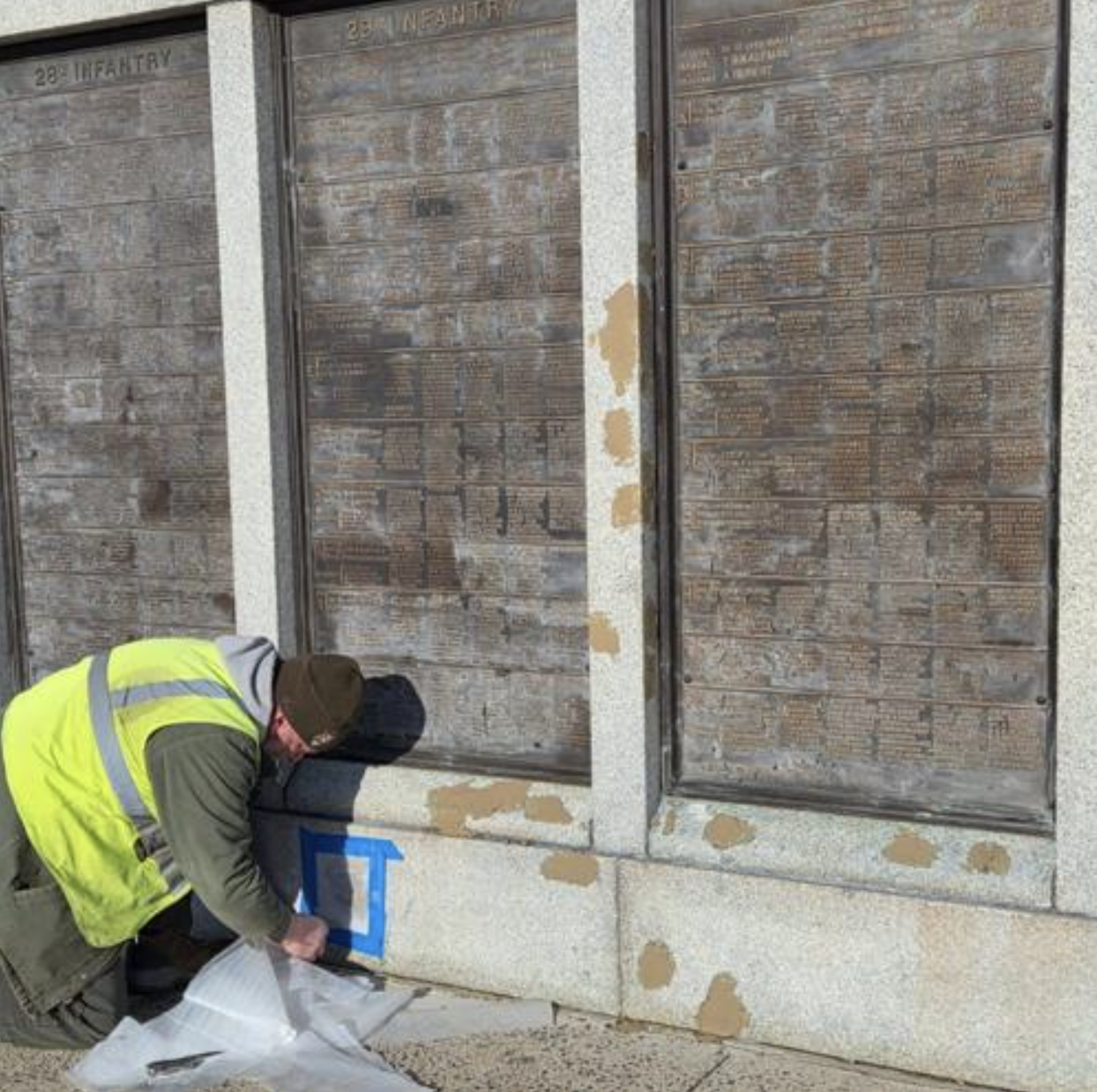
One photo shows a maintenance worker seemingly working on a number of stains on the Pennsylvania Memorial.

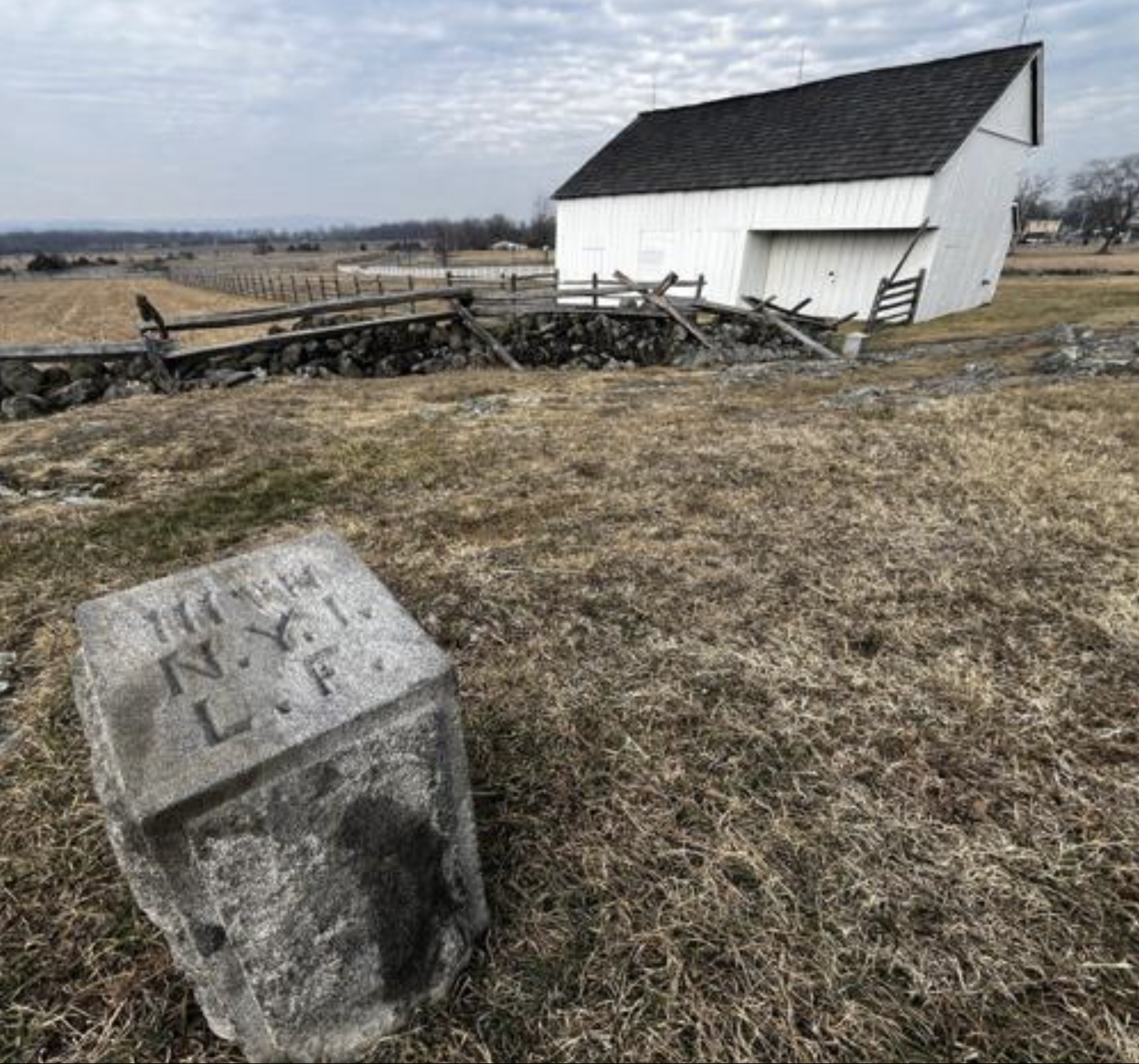
Other pictures show oil damage to the Pennsylvania Independent Batteries C & F monument, the right flank marker of the 6th Maine Battery, and the left flank marker of the 111th New York Infantry.

“While possibly intended as symbolic or ritualistic, the damage is real and lasting. Porous stone absorbs oil deeply, making stains nearly impossible to remove,” the GNMP release reads.

Park officials also addressed the symbolism of the monuments in the post.

“These memorials honor brave soldiers—many of whom died on the very ground where these markers now stand. Adding oil does not honor their memory. It desecrates it,” the release reads.

In September, one of GNMP’s most iconic monuments was vandalized when someone allegedly scratched “LJR” into the side of a bronze plaque on the 44th New York Infantry Monument, also known as the “castle,” on Little Tound Top.

A witness to that incident allegedly saw a man scratching the side of the plaque and subsequently photographed him, Jason Martz, GNMP communications specialist, said at the time.

Anyone who witnesses any suspicious activity in the park is asked to contact staff immediately. The park’s tipline is 888-653-0009.