In late afternoon on Wednesday, September 17, 1862 Union infantry from the IX Corps commanded by Maj. Gen. Ambrose Burnside attacked the Confederate-defended Lower Bridge spanning Antietam Creek in Sharpsburg, Maryland. Like similarly constructed bridges located upstream in Washington County, the stone-arched bridge was nothing unusual.
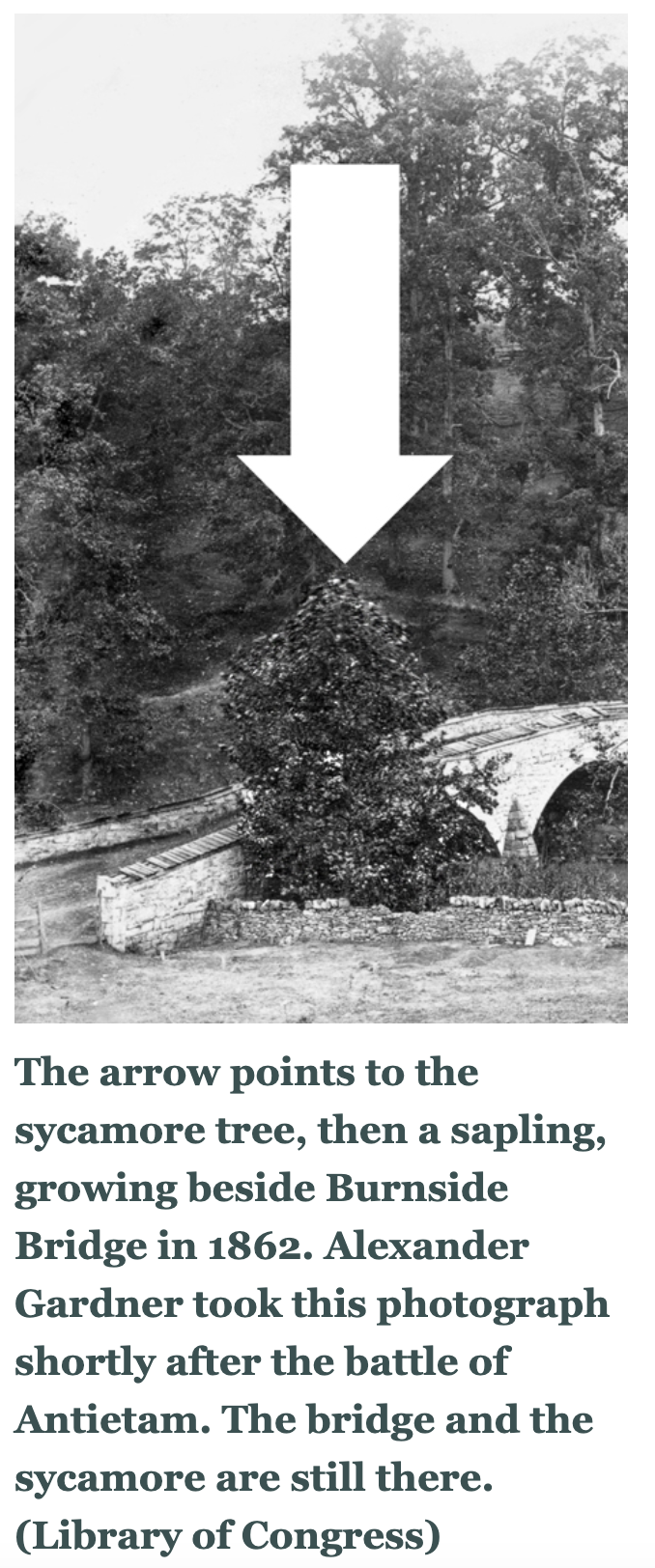
Trees grew along the creek banks adjacent to the bridge. Next to its eastern entrance, literally only a few feet to the north, grew a sycamore, on September 17 a leafed-out sapling perhaps 15 feet tall.
That afternoon Confederate infantry spread along the high ground above the creek’s west bank fired incessantly at the Yankee boys trying to cross the Lower Bridge. Always able to order a charge that he would never lead, Burnside sacrificed a lot of good men before Union troops crossed Antietam Creek via “Burnside Bridge,” as the span became known.
So hot lead flew around the sycamore, which if a tree had ears would have heard the cheering, the gunfire, the screaming, and the dying. The Johnnies withdrew, the Yankees occupied the high ground, and the fighting shifted toward Sharpsburg.
A day or two or three after the battle, Alexander Gardner photographed Burnside Bridge from a spot slightly to the north. The photograph captured the surrounding terrain and trees, including a sycamore growing beside the bridge’s eastern entrance.
That tree became the Burnside Sycamore. Years passed, the land around Burnside Bridge became federal property, and people explored the bridge and the battlefield.
The sycamore grew tall and spread a leafy canopy over the bridge’s eastern entrance. The Antietam periodically flooded, and water swirled around the tree before subsiding. Winters came and went, so did the hot summers, and the years passed.
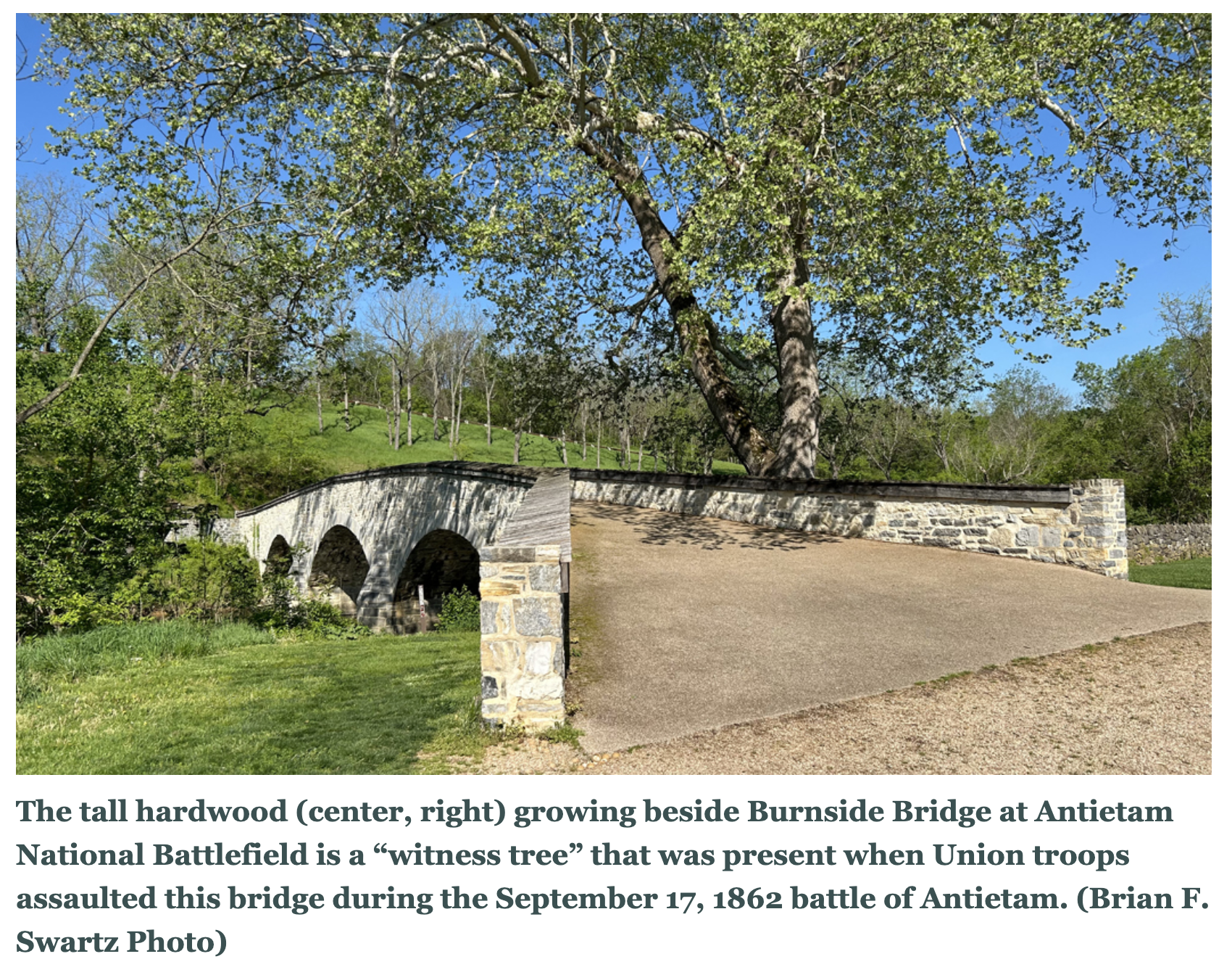
The Burnside Sycamore stood tall on September 17, 1962, the 100th anniversary of the battle of Antietam. Thunderstorms, high winds, and a hurricane really roughed up Antietam National Battlefield in late summer 2003. The National Park Service reported losing 46 Antietam trees, with some more than a century old. The Burnside Sycamore lost three big limbs that fell and damaged the Burnside Bridge. It was promptly repaired.
The Burnside Sycamore stood tall on September 17, 2012, the battle’s 150th anniversary, which like the centennial observance drew a large crowd to Antietam National Battlefield. Many people who explored Burnside Bridge that day probably did not know the sycamore’s history or notice the small sign identifying the tree.
And the Burnside Sycamore stands today, almost 164 years since the bloodiest one-day battle in American history swept over the hills of Sharpsburg. A “witness tree” to that slaughter, the sycamore has seen much over all those years.
If only a tree could talk …
Be sure to subscribe to my YouTube channel, Maine at War: Battlefields, Monuments & More