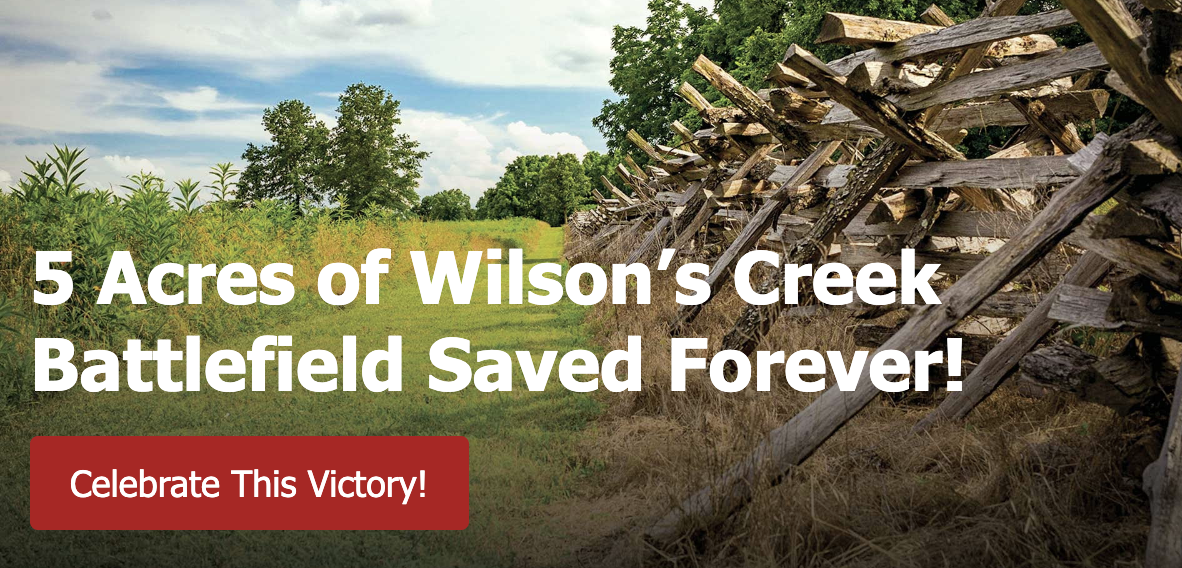
As Thanksgiving approaches, we have another reason to give thanks: your support has helped save five acres at Missouri’s Wilson’s Creek Battlefield! Together, we have protected hallowed ground central to the early-war struggle for control of this divided border state.
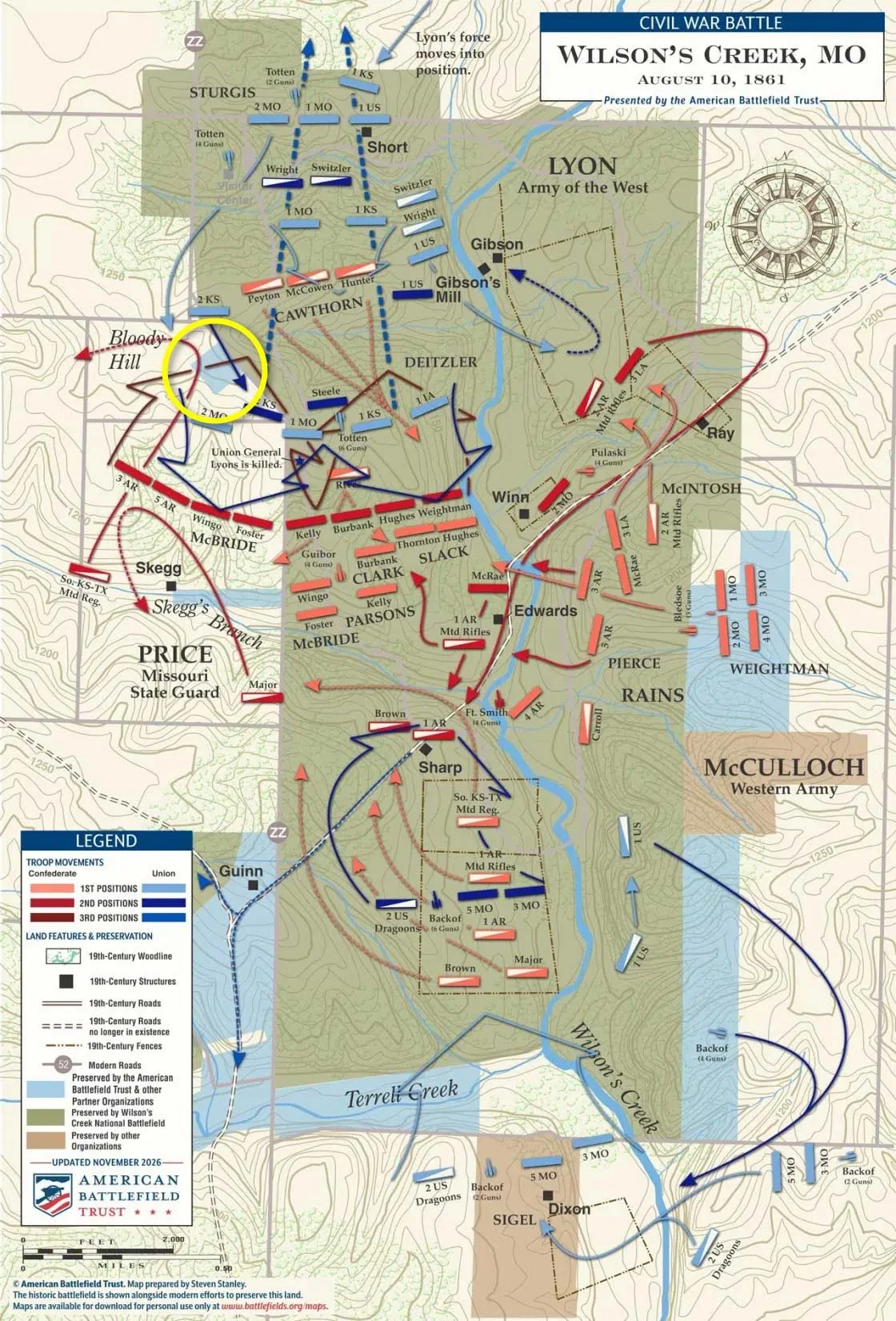
This land, located directly adjacent to Wilson’s Creek National Battlefield, holds an important part of that story. On August 10, 1861, Union soldiers of the 2nd Kansas Infantry crossed this ground to reinforce their line under mounting Confederate fire. The regiment’s right flank rested on the very land you have helped save.
The battlefield is located in Greene County, one of the fastest-growing counties in Missouri. Thanks to you, another piece of this landscape will endure amidst rapid development, preserving the ground that helps us understand what these soldiers experienced.
Alongside your generosity, this project was made possible through support from the American Battlefield Protection Program and the Wilson’s Creek National Battlefield Foundation.
I invite you to learn more about the land we have saved together and the fighting that made it hallowed ground.
The Battle of Wilson’s Creek
In the summer of 1861, Union and Southern forces competed for control of Missouri. On August 9, Brig. Gen. Nathaniel Lyon’s Army of the West marched from Springfield to strike the Southern army led by Maj. Gen. Sterling Price.
The armies collided early the next morning. On the high ground that became known as Bloody Hill, the fighting developed into a series of fierce attacks and counterattacks.
Battle of Wilson's Creek, Aug. 10, 1861, by Kurz & Allison | Library of Congress
Around 9:00 a.m., a major Confederate assault pressed back the Union line. Lyon called upon his reserves, and the 2nd Kansas Infantry advanced from northwest to southeast across the land we have now saved. Taking its place in the Union position, the regiment helped withstand the Southern attacks, including the final assault of the day.
The fighting on Bloody Hill claimed Lyon’s life, making him the first Union general killed in combat during the Civil War. Although the Union line held against repeated assaults, mounting casualties and dwindling ammunition eventually forced the Federals to withdraw. Confederate forces may have won the Battle of Wilson’s Creek, but the engagement was part of broader Union efforts that prevented Missouri from joining the Confederacy.
Today, protecting this ground preserves the story of this battle, giving future generations a more complete understanding of the soldiers' valor and sacrifice. Thank you for making this victory possible and for your continued commitment to saving our nation's hallowed ground.
Our victories are your victories, and I look forward to celebrating even more preservation successes with you soon.
‘Til the battle is won,
David N. Duncan
President
American Battlefield Trust