Dear Preservation Partner,
On the evening of May 1, 1863, Lee and Jackson began discussing a bold plan for how to defeat the Army of the Potomac, now gathering at Chancellorsville. Soon, Lee’s cavalry chief, “Jeb” Stuart, brought the startling news that the Union right flank was exposed. The conversation shifted to how best to reach the vulnerable position. Jackson consulted with staff officers and soldiers from the area and sent his topographical engineer to scout western roads.
Before dawn, Lee and Jackson studied a rough map and chose one of the boldest gambles in American military history. Jackson would lead over 28,000 men by back roads toward the Union right, while Lee used 15,000 infantry along a three-mile front to hold Hooker’s attention. Once Jackson was in position, his attack would leave the Confederate army dangerously divided into three parts. It was a risk with high stakes.
On the morning of May 2, Jackson led his column down Furnace Road. When Union scouts at Hazel Grove spotted the march, Federal artillery fired on his men and alerted Hooker. Hooker correctly saw the move as a threat to his right and warned Maj. Gen. Oliver O. Howard to watch for an attack from the west against his XI Corps. But as the morning passed, Hooker decided Lee was retreating and ordered the III Corps to harass the rear of Jackson’s marching column.
Maj. Gen. Daniel E. Sickles advanced from Hazel Grove toward Catharine Furnace. By mid-afternoon, his troops had overwhelmed Jackson’s rearguard near an unfinished railroad cut and almost captured a whole Georgia regiment. The fighting drew away about 20,000 Union soldiers, leaving Howard’s XI Corps isolated on the right.
Meanwhile, for much of their march, Jackson’s column moved along narrow, uncharted trails. By twice turning away from the Union line, “Stonewall” strengthened Hooker’s belief that the Confederates were retreating. His force then slipped through the Wilderness toward Howard’s unsuspecting troops.
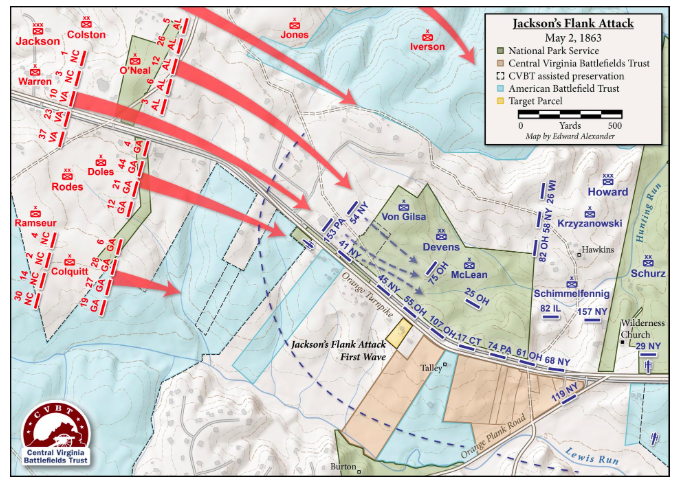
Jackson continued north to the Orange Turnpike, beyond the Union right. Around 3 p.m., his men completed the 12-mile march and formed a battle line nearly two miles long with 11 of his 15 brigades in position for the attack.
Though some Federal soldiers warned that Jackson’s force was nearby, XI Corps headquarters dismissed the reports. With little cavalry on hand to scout the Wilderness, only two small regiments and half a New York battery faced west toward Jackson’s corps.
Late in the afternoon of May 2, 1863, turkeys, rabbits, deer, and other wild game suddenly burst from the woods west of this clearing, amusing XI Corps soldiers as they prepared camp and cooked rations. Moments later, gray-clad soldiers emerged behind them: the first wave of Jackson’s 28,000-man flank attack was in motion. As one Massachusetts soldier recalled, “Along the road it was pandemonium . . . and on the side of the road it was chaos.”
Howard’s men fought bravely, forming three more lines, but their position could not hold. Confederate assaults overran each stand and drove the XI Corps from the field. The rout had begun, and Jackson had reached the height of his success, fame, and military glory.
It was only two brief years after the founding of the Central Virginia Battlefields Trust (CVBT) when a piece of property became available near where Jackson’s famous Chancellorsville flank attack first made contact with XI Corps troops on May 2, 1863. This tract, consisting of just over 5 acres, had been slated for yet another modern building along a rapidly developing Route 3.
Fortunately, CVBT secured the property before any clearing or construction began. When we asked for donations, our preservation partners responded, helping us save the tract and stop its development. In 1999, the parcel was transferred to the National Park Service, adding more than five historic acres to Fredericksburg-Spotsylvania National Military Park. Thanks to generous donors like you, visitors can now look across this part of the battlefield unobstructed and better imagine the events that unfolded there in May 1863.
Since that first acquisition along the route of Jackson’s Chancellorsville flank attack, CVBT’s supporters have helped us acquire or assist with ten other tracts totaling over 110 acres. All ten of the most recent acquisitions have been on the south side of Route 3. These purchases have allowed us to piece together an amazing amount of road-fronting acreage over the years.
It only seems fitting that in this, CVBT’s 30th Anniversary year, yet another flank attack property, nearly across the road from the original one purchased in 1998, would become available to add to the ever-growing list of what is becoming a battlefield preservation corridor along modern Route 3.
This new two-acre tract, which we call Jackson’s Flank Attack—First Wave, is a vital connector parcel. It will help link the many properties CVBT has preserved to the east with land saved by our friends at the American Battlefield Trust to the west. Thanks to generous supporters across the United States, the nearly 30-year dream of preserving the Chancellorsville flank attack route is becoming a reality—one parcel at a time. Thank you!
We need to raise $125,000 to preserve this property. Will you help us save it?
This land marks the position where some XI Corps troops of the Army of the Potomac first encountered the opening wave of Jackson’s flank attack.
Writing about the early fighting near this site, Union Col. John C. Lee of the 55th Ohio noted: “Soon the men and officers on our right flank began to give way, and to retreat to the eastward in our rear in a disorganized form. The battery that had run up so close to us began to deliver grape and canister right along the road and was very destructive to our line which occupied the south side of the road, with a slight barricade made out of fence rails, with earth thrown on them. Our line still fronted to the south.” Col. Lee rode to Brig. Gen. Charles Devens and Brig. Gen. Nathaniel McLean who commanded the division and brigade respectively and asked if he should change his front to face west to meet Jackson’s large force. Devens did not answer, and McLean told Lee, “Not yet.” Lee rode back to his unit who had moved to the north side of the road due to the “raking fire” from the Confederates and rode back to Devens and McLean to report the rapidly deteriorating situation.
Receiving no instructions, only a dismissive wave, Lee rode back. “The enemy were slowly approaching with constant firing, and we were unable to get off a shot,” Lee explained. At his return, Col. Lee’s horse was shot from under him. Stunned and bruised, he joined the retreat. With others, Lee rallied for a defensive stand near Dowdall’s Tavern. However, Jackson’s force outflanked and overwhelmed their attempt to hold, and Col. Lee and the others had to continue to retreat eastward.
Jackson’s bold maneuver made history. Its success helped secure the Confederate victory at Chancellorsville and shaped later decisions by both armies that influenced the war’s outcome. Military leaders still study the flank attack today.
Together, we can carry CVBT’s 30-year legacy forward by preserving this important parcel. Please consider supporting this campaign so future generations can experience this battlefield landscape and understand the history that still resonates so strongly today.
Sincerely,
Tom Van Winkle
CVBT President